
Simplifying AI Writing: Template for Breaking Down Complex Concepts
in Productivity

AI prompts can often seem like complex and mysterious processes. I've broken them into essential components to better understand these concepts. The following is a list of critical elements that make up a piece of writing, designed to be as broad and general as possible to be applied to various writing subjects.
Aspects of Writing
- Level of Detail (Detailed, Concise)
- Length (One sentence, four Paragraphs)
- Structure (Haiku, poem, essay, Article, short story, novella)
- Setting (Small Town, Post-Apocalyptic Wasteland, A Magical Forest)
- Genre (Action, Romance, Drama, Western, Journalistic Writing)
- Story elements (Conflict, suspense, resolution, climax, setting)
- Word Choice (Idioms, Figures of Speech, Slang, Jargon, Imagery, metaphors, similes, dialog, rhyme, alliteration)
- Perspective (First-person, second-person, third-person, omniscient, limited omniscient, objective)
- Pacing (Fast, Slow, variable)
- Tone (Humorous, Inspiring, Professional, Casual, Mocking, Persuasive)
Using The Template
Here's a prompt I am using when I am using ChatGPT for writing.
Write a [Length], [Pacing] paced, [Level of Detail], and [Tone] [Structure] in the [Genre] genre set in a [Setting] with [Story Elements] and [Ammount] [Word Choice] from the [Point of View] point of view. [Story Prompt]
A Short Story
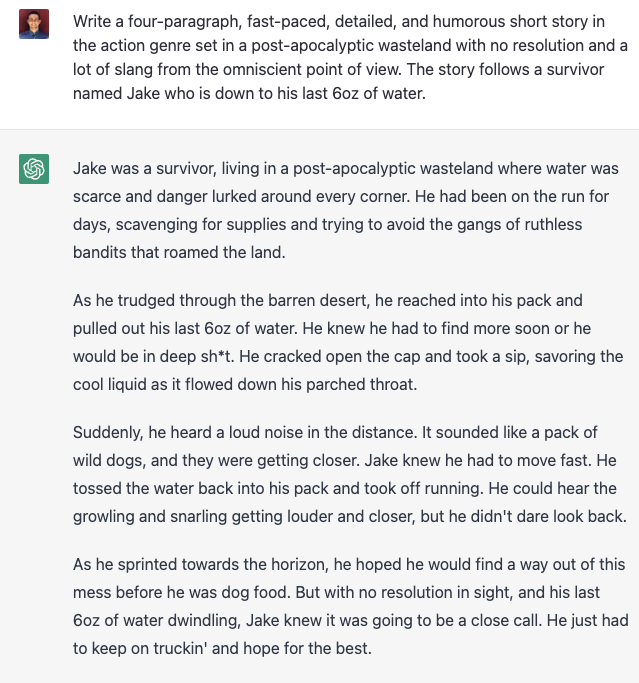
Write a four-paragraph, fast paced, detailed, and humorous short story in the action genre set in a post-apocalyptic wasteland with no resolution and a lot of slang from the omniscient point of view. The story follows a survivor named Jake who is down to his last 6oz of water.
Professional Writing
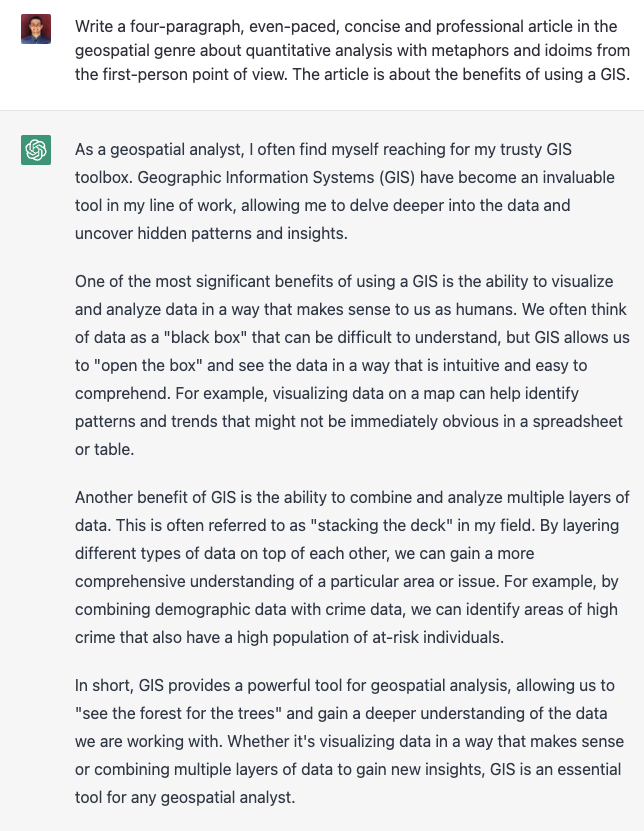
Write a three-paragraph, even-paced concise and professional article in the geospatial genre about quantitative analysis with metaphors and idoims from the first-person point of view. The article is about the benefits of using a GIS.
Conclusion
Working with a template is a great way to get the most out of GPT's capabilities. By providing GPT with a specific structure and guidelines, I can have more control over the final output. Instead of leaving it up to GPT to decide on the tone, pacing, and other variables, I can specify them explicitly. This way, I can ensure that the final output aligns with my intended style and purpose. Additionally, using a template can also save time by reducing the need for editing and revisions. It can also be helpful in situations where you want to maintain consistency within a series of texts, for example, an article series or a book. Overall, a template can be a powerful tool for creating high-quality and coherent text with GPT.
Comments
- I like this
Login to Comment


Related Posts
 12 min read
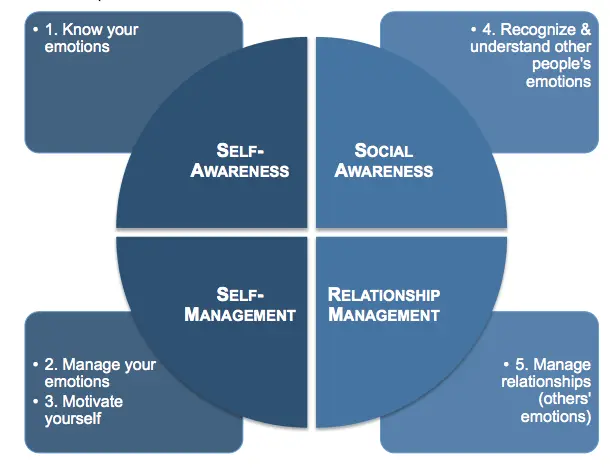
Learn about Emotional Intelligence 2.0 and strategies for increasing EQ, such as body language, controlling emotions, cultural norms, and constructive feedback.

0
 10 min read
Be ready for your geospatial professional job interview by familiarizing yourself with a wide range of questions organized into various categories.
0
 22 min read
Learn the key terms and concepts behind intuition pumps to sharpen your mind and make better decisions. Dive deeper with my comprehensive guide.
0

John Solly
A hands-on AI practitioner who transitioned to a CTO role to broaden my impact.
Most of my career has been dedicated to developing spatial systems at Esri, startups, and federal agencies. Currently, I lead technology strategy for Leidos' Health IT division, supporting agencies such as SSA, VA, and HHS.
My primary focus is the convergence of spatial computing and AI, enabling machines to interpret the physical world and applying these capabilities to meaningful missions.
Please reach out if you are interested in spatial systems or advancing AI within the federal government.